Why Interior Designers Are Swapping Ordinary Bathroom Mirrors for LED Vanity Mirrors

Why Interior Designers Are Swapping Ordinary Bathroom Mirrors for LED Vanity Mirrors
There is a quiet shift happening in all bathroom interior designers' touch right now. The standard flat mirror — that frameless rectangle you have had on your wall for a decade, lit by a pair of sconces that cast shadows exactly where you need them least — is being replaced. Not upgraded. Replaced.
The thing that is taking its place is an LED vanity mirror: a wall-mounted mirror with precision lighting engineered directly into the glass, designed to give you a true, shadow-free, colour-accurate view of your face regardless of what the rest of your bathroom lighting is doing.
Designers started making this swap for their clients years ago. The rest of us are catching on — and once you understand what the technology does and why it matters, it becomes immediately obvious why no serious bathroom renovation is being finished without one.
This is everything you need to know about LED vanity mirrors: what they do, how they differ from each other, what the specifications mean, and how to choose the one that belongs in your bathroom.
The Problem with How Most Bathrooms Are Lighted
Before we talk about what an LED vanity mirror does, it helps to understand the specific problem it solves, because most people have been living with the problem for so long that they have stopped noticing it.
Standard bathroom lighting — an overhead fixture, a pair of sconces flanking the mirror, or recessed cans in the ceiling — is designed to illuminate the room, not your face. The light source is almost always above you, behind you, or to the side. This means shadow falls directly on the areas you most need to see clearly: under your eyes, along your jawline, around your nose, and on your neck.
You compensate, probably without realizing it. You lean in. You tilt your head. You move to a different room with better light. You apply your makeup, step outside, and discover it looks completely different in daylight.
An LED vanity mirror eliminates the root cause of all of that. By placing the light source at or around the mirror surface itself — in front of you, at face level, pointing directly at you — it lights your face the way a professional studio lights a subject: evenly, without shadow, in colour temperatures you can control.
What Interior Designers Actually Look for in an LED Vanity Mirror
Interior designers are not specifying LED bathroom mirrors because they look good in photos, although they do. They are specifying them because of what the technology delivers on a technical level. Here are the five specifications that professional designers evaluate — and that you should too.
1. Colour Rendering Index (CRI)
CRI measures how accurately a light source renders colour compared to natural daylight, on a scale of 1 to 100. A standard bathroom bulb might have a CRI of 70–80, meaning colours look slightly distorted under it. Professional makeup studios and photography studios target CRI 90 and above.
The Electric Mirror Brand, available at Perfect Makeup Mirrors, has a CRI of 95+ — essentially indistinguishable from the colour of natural daylight.
Why it matters: If you apply your makeup under a low-CRI light and then step outside, the colours look different because you applied them under inaccurate light. A high-CRI LED vanity mirror shows you your face exactly as others will see it — in any environment.
2. Colour Temperature
Colour temperature, measured in degrees Kelvin (K), determines whether the light reads as warm (yellowish), neutral, or cool (blueish white). For a bathroom mirror, this is one of the most consequential decisions you will make.
3,000°K is close to traditional incandescent bulbs — warm, flattering, ideal for evening lighting or for spaces with warm finishes like brass or wood. 5,000–5,500°K approaches natural daylight — accurate, bright, and essential if you want your grooming to match how you look outside.
The best LED vanity mirrors give you control over this. Designers value this flexibility because the right colour temperature depends on the time of day and what you are doing — skincare versus makeup application versus grooming.
3. Luminous Output (Lumens)
Not all LED mirrors are equally bright. Lumens measure the total amount of light output, and there is a meaningful difference between a mirror with 47 Lumens and one rated at 950 Lumens.
The rule of thumb: the more precise your grooming tasks, and the more you rely on your mirror as a primary light source, the more lumens you want.
The Difference Between Backlit, Front-Lit, and Halo LED Mirrors
One of the most common points of confusion when shopping for an LED bathroom mirror is the difference between the three main lighting configurations. Here is how to think about each one.
Backlit (Edge-Lit) LED Mirrors
The LEDs are positioned behind the mirror glass and illuminate outward from the edges, creating a soft glowing halo around the mirror’s perimeter. The effect is atmospheric and architectural — the mirror appears to float off the wall in a ring of soft light. Backlit mirrors are exceptionally popular in current bathroom design because they contribute to the aesthetic of the bathroom as much as they contribute to function. The Electric Mirror uses a variation of this approach with its frosted top-panel LED array, producing no hotspots and no dead zones — just even, high-CRI light across the entire panel.
Front-Lit (Perimeter) LED Mirrors
The LEDs are integrated into the mirror’s frame or surround, pointing forward and directly illuminating your face. This is the highest-performance configuration for grooming tasks because the light is pointing at you rather than around you, giving you the brightness and accuracy of studio-style front lighting in your bathroom.
Some LED vanity mirrors combine both front-lit and backlit configurations in a single fixture, giving you precision face lighting alongside atmospheric perimeter glow.
Halo (Circular Perimeter) LED Mirrors
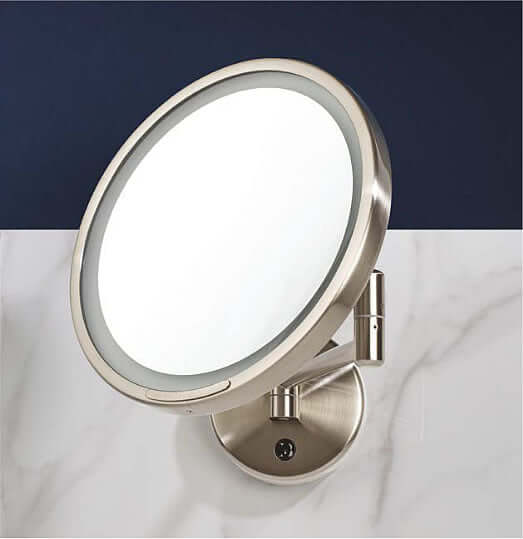
The LEDs form a ring of light around the mirror face, producing the “halo” effect familiar from film and television green rooms — soft, even illumination that flatters the subject rather than exposing harsh shadows. The halo configuration is the choice designers most frequently use when the mirror needs to be both functional and visually elegant.
2026 Design Trends: What Designers Are Actually Specifying
The data on this is clear. Today, the bathroom mirror has evolved from a functional afterthought into the visual and functional centrepiece of the entire vanity wall. Here are the specific directions professionals are moving in.
Frameless and Flush
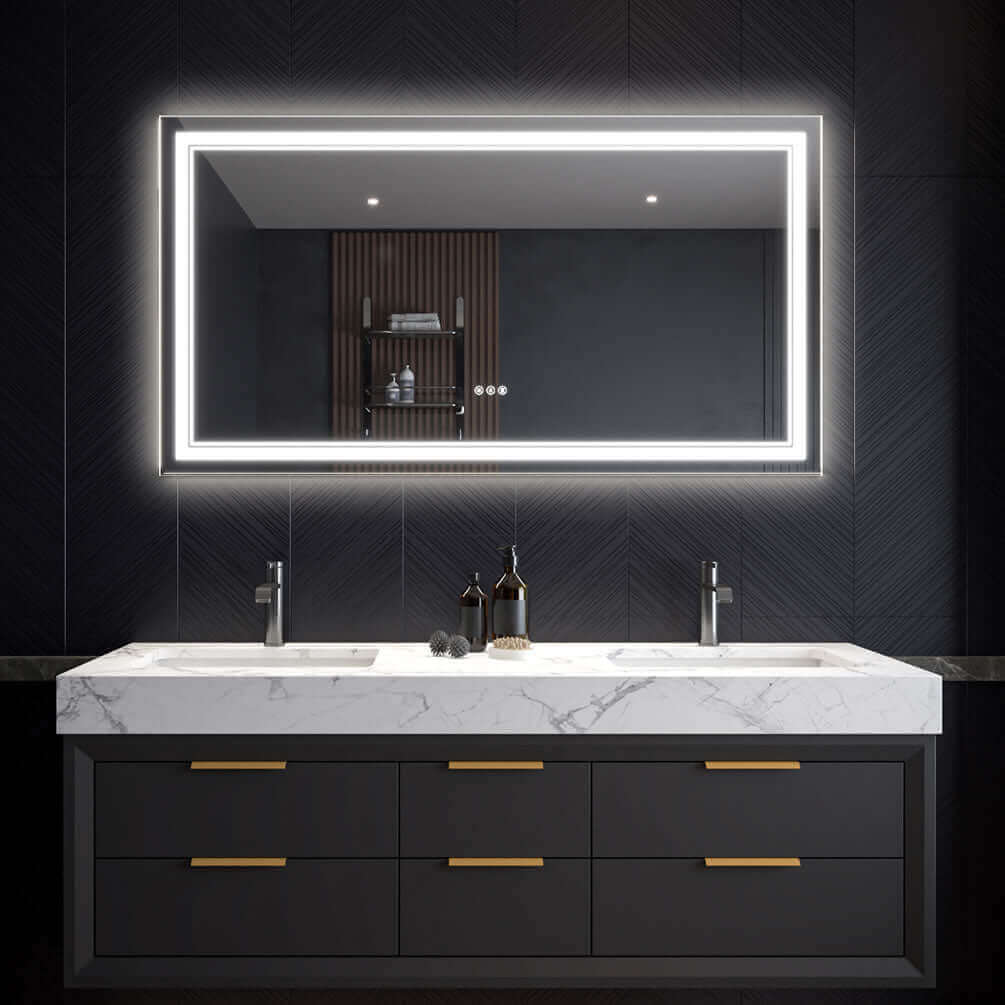
Heavy ornate frames are being replaced by frameless or minimally framed LED mirrors. The clean, uninterrupted line of a frameless backlit mirror on a wall of neutral stone or large-format tile has become one of the defining looks of the high-end bathroom today. It makes the space feel larger, quieter, and more intentional. The Electric Mirror, at under one inch of overall depth, achieves exactly this effect.
Switchable Colour Temperature as a Must-Have
The ability to switch between warm and daylight colour temperatures — rather than being locked into one — has moved from a premium feature to a baseline expectation in the design community. The PMM LED vanity mirror with switchable colour temperature is from the Mirror Luxe range.
Bathroom ROI
Designers are also driven by hard numbers. Before-and-after projects consistently show that a quality mirror upgrade delivers up to a 15% lift in bathroom ROI — and for homeowners preparing to sell, or anyone who has spent significantly on a renovation and wants the space to photograph well, a statement LED vanity mirror is one of the single most cost-efficient upgrades available.
Why Perfect Makeup Mirrors Is Where Designers Shop
There is a reason interior designers and trade professionals order from Perfect Makeup Mirrors rather than from home improvement chains or marketplace platforms. PMM is a specialty retailer built specifically for this category, and the difference in product quality, knowledge, and service reflects that.
Every LED mirror PMM carries is glass, not plastic. Electric Mirror (trade-grade, hotel-quality) Award winner) are not widely stocked at general retailers — these are the professional tier, available in one curated place.
PMM stocks hardwired LED vanity mirror models across every major finish and size. To-The-Trade pricing is available for designers, developers, and commercial buyers. Free ground shipping on orders within the contiguous 48 US states. Expert team support for specification questions.
If you are doing this right — if you want a mirror that will still look and perform like new in a decade — you are not buying it off a shelf at a chain store.
FAQ: LED Vanity Mirrors — Your Questions Answered
Q: What is an LED vanity mirror?
An LED vanity mirror is a bathroom mirror with LED lighting integrated directly into its structure — either around its perimeter, behind the glass, or in a halo formation around its face, or a combination of these. Unlike standard mirrors lit by separate wall fixtures, an LED vanity mirror places the light source at face level, in front of the subject, producing even illumination without shadows. Some are High-quality models that include adjustable colour temperature and a UL-listed electrical system.
Q: What is the best colour temperature for a bathroom mirror?
For grooming and makeup application, 5,000–5,500°K (daylight) provides the most accurate colour rendering and matches how you will look in natural outdoor light. For a more flattering, warmer feel — or to match warm bathroom finishes — 3,000–3,500°K is preferred. The ideal solution is a mirror with switchable colour temperatures — some models allow you to toggle between warm and daylight settings with a single switch or touch control.
Q: What is the difference between a backlit and a front-lit LED bathroom mirror?
A backlit (edge-lit) LED mirror has LEDs positioned behind the glass that create a soft ambient glow around the mirror’s perimeter — primarily an atmospheric and architectural effect. A front-lit (perimeter-lit) mirror has LEDs integrated into the frame or surround that point forward, directly illuminating your face for precision grooming. In practice, the best LED vanity mirrors combine both: a front-lit perimeter for accuracy and a backlit glow for aesthetics.
Q: How long do LED vanity mirrors last?
The LED elements in premium vanity mirrors are rated for 50,000 to 70,000 hours of use. At two hours per day, 70,000 hours equate to approximately 96 years of operation. LED lighting does not burn out in the traditional sense — it very gradually dims over its lifespan. Electric Mirror vanity mirrors carry a 5-year manufacturer’s warranty and are trade-grade and engineered for hotel-level daily use.
The Mirror Is the Room
Interior designers have known for years what homeowners are discovering today: the bathroom mirror is not a background element. It is the room’s centre of gravity — the thing your eye goes to first, the surface that defines how well the space works every single morning, and the one upgrade with the most direct impact on how you look, how you feel, and how much you enjoy the time you spend getting ready.
An LED vanity mirror is not a luxury add-on. It is the correct solution to a problem that most standard bathrooms have never solved: lighting that works for the person using it.
With the right colour temperature, the right CRI, and the right finish — matched to your bathroom and your daily routine — it is the kind of upgrade that you notice every single morning for the rest of the time you live in that house.
That is what interior designers already know. Now you do too.